

2026-07-10
Studying in Madrid: Austėja Shares Why She Chose the City and Her Advice for Students
Sometimes, all it takes is one inspiring teacher for a student to discover the path they want to pursue in life. That was exactly the case for Austėja Šaltytė, a Lithuanian student currently studying in Spain. It was her business teacher at Erudito Licėjus who sparked her interest in the world of business and finance, […]
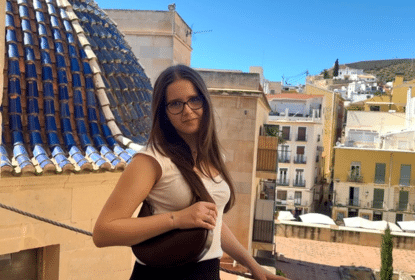
Sometimes, all it takes is one inspiring teacher for a student to discover the path they want to pursue in life. That was exactly the case for Austėja Šaltytė, a Lithuanian student currently studying in Spain. It was her business teacher at Erudito Licėjus who sparked her interest in the world of business and finance, helping her realise that knowledge in this field opens the door to a wide range of opportunities across industries and international sectors. Austėja shares her experience of choosing to study abroad and the advantages that have come with this decision.
– How would you describe yourself to someone who has never met you?
– First impressions can be misleading. Many people say I seem quiet and reserved at first, but those who get to know me soon realise that I’m actually very talkative, energetic, and determined. That’s why I like to say that I’m full of surprises.
– How did you do at school, and how did your final exams go? Were you someone who planned everything well in advance?
– My studies at Erudito Licėjus went very well from the very beginning. After achieving excellent results in the entrance examinations, I was awarded a scholarship that covered most of my tuition fees, and I maintained strong academic performance all the way through to my final exams. I started preparing for the exams well in advance. Of course, I was nervous, but I knew I had done everything I could. I’m very happy with my results, and today I’m proud to be studying at Geneva Business School. My current GPA is 5.5 out of 6, and my upcoming third internship in Vilnius motivates me even more.
– Why did you choose to study International Business and Finance? What attracts you most to this field?
– At Erudito Licėjus, I had an outstanding Business teacher whose engaging lessons inspired me to pursue International Business and Finance. Thanks to him, I realised what fascinates me most about this field: the incredible variety of opportunities it offers, opening doors to countless industries, international companies, and even the possibility of starting your own business.
– How did you choose your university? What criteria were most important when making your decision?
– I applied to five universities abroad, in countries including the Netherlands, Germany, and Spain. My main priority was finding a university with a strong focus on business. A high-quality academic programme, strong reputation, and an international environment were the factors that mattered most to me.
– What attracted you most to Geneva Business School?
– What appealed to me most about Geneva Business School was its approach to education. I wanted to study at a university that would not only provide theoretical knowledge but also teach me how to apply it in real-life situations. I was particularly drawn to the fact that many of my professors are experts in their fields, actively working in industry or running their own businesses.
Another major advantage is the university’s relatively small size. It allows me to discuss topics in depth during lectures, while also building closer relationships with fellow students, professors, and the administrative staff. I feel comfortable at the university—I can confidently ask questions and even suggest adjustments to classes based on students’ needs. This supportive environment naturally encouraged me to become involved in the Student Council. For me, the university is a place where I truly feel I can grow.
– Why did you choose Madrid? What appealed to you about the city?
– Geneva Business School has campuses in Barcelona, Madrid, and Geneva. Madrid seemed like the best fit for me. It’s a city that’s very comfortable for students to live and study in—safe, vibrant, and full of young people. I especially appreciate how much Spain supports students. Most museums are free to visit, and a monthly metro pass costs no more than €10. Although I initially considered Barcelona, after doing more research I realised that Madrid would be the safer choice for me.
– How has living and studying abroad changed you as a person?
– Living abroad has made me more independent and confident. I’ve learned how to take care of myself, make decisions on my own, and embrace uncertainty instead of fearing it. I can clearly see how much I’ve changed, grown, and come to understand myself better. I believe that’s incredibly important at this stage of life.
– Was it difficult to adjust to living abroad and becoming independent?
– The hardest part was saying goodbye to my family and friends in Lithuania without knowing exactly when I’d see them again. Although the beginning wasn’t easy, I soon found close friends in Madrid—people I now miss just as much whenever I’m back in Lithuania.
– What advice would you give Year 12 students on managing stress during exam season?
– The biggest piece of advice I can give is not to forget about yourself. Personally, I loved studying together with my friends, and some of my fondest memories are the hours we spent preparing together in libraries. Having that support network made a huge difference and really helped me cope with the stress.
– What advice would you give to young people who still haven’t decided what to study or which university to choose?
– Start thinking about it as early as possible. Before Year 11, I never imagined I would end up studying International Business and Finance. I would strongly recommend attending university fairs—I started going to them quite early. They gave me the opportunity to meet university representatives in person and learn much more about both the study programmes and the universities themselves.
– JYou already have considerable internship experience. How has that benefited you as a student?
–
My own experience quickly taught me that good grades alone don’t guarantee an internship. Most companies give preference to students who already have some practical experience, so my advice is to start looking for opportunities as early as possible. By the end of my first year at university, I had already completed two internships—one at a risk consulting company and another at a bank.
Each internship gave me a better understanding of the world of finance and showed me how things work in practice. They also helped me discover which areas of finance I enjoy most. Even the application process itself was an important learning experience. My first interviews weren’t successful because I simply didn’t know what to expect. However, each interview taught me how to prepare more effectively, what knowledge I needed, and how to answer questions with greater confidence.
– How should students choose the companies where they complete internships?
– I believe the most important thing is to choose a company based on the field that genuinely interests you, rather than simply its reputation. Your first internships should help build a strong foundation for your future career. You can always aim for a globally recognised company later, but without solid knowledge and practical experience, even the most prestigious employers are unlikely to consider your application.
– Is it better to intern in the field you plan to work in, or should students explore different industries?
– I think it depends on your field of study. Since I’m studying International Business and Finance, I have quite a broad range of opportunities. Personally, I’ve never been afraid to apply for positions that weren’t directly related to finance. I’ve always chosen opportunities that genuinely interested me. A great example is my internship in financial crime prevention, which turned out to be an incredibly valuable experience.
– What financial challenges did you face when you first started studying abroad? What kind of budget did you need? Did you work during your studies, or do you plan to?
– I study at a private university, so tuition is a significant expense. The biggest part of my monthly budget goes towards renting a room, and accommodation closer to the city centre is considerably more expensive. On the other hand, groceries, toiletries, and clothing are all much cheaper than they are in Lithuania. I don’t work during my studies because my parents support me financially. Thanks to that, I’m able to focus entirely on my studies and achieving the best possible results.
– What are your plans after graduating in Spain? Do you see yourself pursuing a master’s degree, moving to another country, or returning to Lithuania?
– After completing my bachelor’s degree, I’m considering pursuing a master’s degree in another country, although I haven’t made a final decision yet. What I do know is that I see myself working for an international company—perhaps even one based in Lithuania.
Join us
Register for a visit to the school and become part of our community!