

Information for parents
TIMETABLE
Vilnius

Kaunas

AGENDA AT THE SCHOOL
When organizing education at Erudito Licėjus, it is important to allow pupils to experience and perceive the connections between their efforts and outcome. The teacher needs to focus on the process that reveals the relationship between goal- effort-outcome. Different class groups work on slightly different agendas at Erudito Licėjus. Lessons are organized this way for several reasons:
- School opening hours: Monday – Thursday 8 a.m. – 6 p.m; Fridays 8 a.m. – 5 p.m.
- Most lessons are organized in the form of blocks (double lessons). Therefore, we take breaks between blocks but not in the middle of them.
- Lessons are organized in a block format at Erudito Licėjus. The duration of the blocks is 75 minutes for grades 0–1, and 90 minutes for grades 2–12.
- Thanks to such a longer lesson duration, teachers have more time to organize more diverse and inclusive educational activities and to apply active educational methods.
- In the middle of the lesson, pupils take a short agile break, or agile and active methods are combined throughout the duration of the block.
- Primary school classes have 3 blocks per day, grades 5–7 have 3.5 blocks daily, and grades 8–10 have days in the middle of the week when they have 4 blocks.
- Since different grades at our school are attended by children from the same families (siblings), we want to organize the lessons so that they end at nearly the same time for most grades, with as few pupils as possible from different grades gathering in the canteen during breakfast and lunch. After staggering the lunch times of different grades, we managed to prevent crowding in the corridors during that time.
- With the school working to different schedules, using a school bell becomes impractical. Lessons at Erudito Licėjus begin and end when the teacher announces.
- The primary school teachers prepare a schedule for primary classes and place it in ManageBac.
- Of The timetable for the lower-secondary classes and gymnasium grades is prepared for six months at a time.
- All contextual and outgoing lessons outside Vilnius or Kaunas are organized for an additional fee, which the homeroom teacher coordinates with the parents. Once approved with the families, the school organizes a planned contextual outgoing lesson. The school allocates the budget for contextual / educational lessons outside the school in Vilnius and Kaunas cities.
TIMETABLE
- Homeroom teachers will share primary school timetables in a closed-class Facebook group.
- Secondary school timetables will be shared by e-mail or other communication means used by homeroom teachers.
SCHOOL OPENING HOURS AND SCHOOL ACCESS
The school’s working hours are from 8:00 AM–6:00 PM., on Fridays – until 5:00 PM.
Students can enter the school only through Aguonų st 26 Main entrance in Vilnius and through J. Gruodžio st 9-1 in Kaunas.
From 8:00–9:15 AM, the school doors are opened (it works without access cards); at that time, a school employee on duty will greet you at the entrance.
9:15–2:45 PM – Formal education (lessons) are currently taking place.
To ensure proper safeguarding for the safety of our students, we can not release students from lessons without advanced notice to the homeroom teacher and school administrator
(vilnius@erudito.lt). Additionally, should parents and external visitors wish to enter the school, they will first need expressed permission from the administration.
2:45–3:15 PM class end time. At this time, the main front door is opened, and an employee on duty monitors the dismissal of students.
3:15–6:00 PM (on Fridays until 5:00 PM) – after-school activity time.
CHILDREN PICK UP AFTER SCHOOL
After lessons
- Children in grades 0–1, who study on the 1st floor of the building, can be picked up from their classroom after the end of classes (2:15–3:00 PM).
- Parents of students in grades 2–4 are asked to wait in the lobby on the 1st floor until they finish the session and come down.
- Students of grades 5–12 leave the school independently after their lessons..
After school clubs
As the school expands and to ensure the safety of the students and avoid disruptions to informal educational activities, we are limiting the presence of outside individuals within the school premises. Therefore, the pickup of children from the after-school activities will follow the schedule below:
3:45 PM–4:15 PM
4:45 PM–5:15 PM
5:45 PM–6:00 PM
During the specified periods, please arrive at the school to wait for your children on the first floor of the school building. Upon your child’s arrival, you can accompany them to the cloakroom if needed.
As we encourage a sense of responsibility and independence in our young scholars, we aim for them to learn time management skills and adhere to routines. Therefore, we kindly request your assistance as well – please discuss with your children in the mornings when you pick them up.
STUDENT LOCKERS
VILNIUS
Lockers for students in grades 0, 1, 2, and 4 can be found by entering through the main entrance and descending to the -1 floor.
Lockers for 3rd-grade students are located on the -1 floor of the new building. After entering the building through the main entrance, follow the corridor to the new wing and descend to the -1 floor. Lockers for older grade students will be situated on their respective floors.
KAUNAS
Lockers for students in grades 0-2 can be found by entering through the main entrance. To reach the locker room, walk along the first-floor corridor all the way to the exit doors leading to the inner courtyard of the Lyceum.
The lockers for 3-7 grade students are located on the first floor of Building A near the main entrance of the Erudito Licėjus.
The lock rooms for 8-12 grade students are located on the first floor of Building B near both entrances, as well as on the third floor.
SCHOOL MEALS
School meals are provided daily, and students should not bring in food from outside the premises. We encourage students celebrating birthdays and other special occasions to do so without cakes and pastries. In Erudito Licėjus, several students have severe allergies, and we want to support a nurturing and inclusive environment where all our students can thrive.
Thank you for your understanding and cooperation, and best wishes for an exciting and successful school year.
School Year Start and End
-
Start of academic year: September 1, 2025
-
End of primary school: June 17, 2026
-
End of lower secondary school: June 23, 2026
Student Breaks
-
Autumn break: November 3–7, 2025 (5 working days)
-
Christmas (Winter) break: December 22, 2025 – January 2, 2026 (6 working days)
-
Winter break: February 17–20, 2026 (4 working days)
-
Spring break – primary classes: March 30 – April 10, 2026 (9 working days)
-
Spring break – basic classes: April 7–10, 2026 (4 working days)
Public Holidays (Non-working Days)
-
November 1–2, 2025
-
December 24–26, 2025
-
January 1, 2026
-
February 16, 2026
-
March 11, 2026
-
April 6, 2026 (Second day of Easter)
-
May 1, 2026
-
June 24, 2026
-
July 6, 2026
-
August 15, 2026
We would like to remind you that all students must complete their health check by September 15th. There is no need to send the certificate to the school; we will be able to see the valid health certificate in the e-health system (submitted by September 15th).
We have introduced an educational tools fee, which is intended to support the resources used for education, enabling students to learn effectively. We want to assure you that the school will fully provide textbooks, workbooks and office supplies ensuring that students have everything they need for their studies.
The breakdown of the fee is as follows:
- Printed and digital textbooks and workbooks;
- Learning programs, applications, platforms, and digitals resources related to students’ education;
- Materials for specialized classes such as arts, music, technology, computer science, natural sciences, and more;
- Digital devices (tablets, Chromebooks, calculators, etc.) used for students’ individual learning;
- Office supplies – paper, watercolors, pencils, scissors, glue, etc.
We want to emphasize that students should purchase and take care of these personal writing tools throughout the entire school year – pens, ink cartridges, regular pencils, erasers, rulers. In elementary school students should have few notebooks with squares and lines according to their grade; in secondary school writing notebooks should be purchased for each subject. In unforeseen circumstances, we will also have these tools available in the classrooms, ensuring an uninterrupted learning process. Starting from the fifth grade and higher, students should also have a personal computer.
Recommendations for computers:
- 13 inch screen
- Inteli5 (or similar) processor
- 4-8GB RAM capacity
- SSD drive
School’s working hours are from 8:00 AM to 6:00 PM, and on Fridays from 8:00 AM to 5:00 PM.
As the winter season approaches and daylight hours shorten, we want to draw your attention to the safe commute to and from school and highlight a few key points:
1. Proper attire. Please ensure that your children are dressed appropriately in the morning and evening. Dark clothing does not reflect light well, so we recommend choosing bright or light-colored clothing.
2. Reflective elements. Reflective belts and other accessories can improve children’s visibility. We encourage their use when going to and returning from school.
3. We would like to remind you that there are two pedestrian crossings, approximately 100 meters to the left and right of the school. If you cannot drop off your children near the crossings, please disembark them on the same side as the school.
4. Please discuss and remind your children of safe traffic rules (e.g., not running across the street, looking in all directions) to ensure they can safely arrive at school without jeopardizing their health.
We seek the highest standards in the learning process and believe that this should be reflected in the behavior and appearance of lyceum students. Lyceum students are required to wear the school uniform everyday except Friday. Please also wear uniforms during lyceum events, when representing Erudito Licėjus in competitions or other representative activities. The school does not allow bright make-up, varnished nails, dangling earrings. Students’ hair must also be neatly combed. It is mandatory to wear indoor shoes at school. Children leave outdoor shoes in the locker room.
School uniform is mandatory from Monday to Thursday, on Friday students can wear their own clothing. We are attaching to this letter the procedure for wearing uniforms.
We invite you to place orders for school uniforms as soon as possible to our partners in the Monomyonline store monomy.lt Uniforms will be sent by DPD couriers until the last week of August. Orders might be prepared later than the start of the academic year but no later than November.
Uniform sets for girls:
- 0–8 grades – pleated school dress (short and / or long sleeves) and Bomber jacket;
- 9–12 grades – school polo dress and Bomber jacket;
- 5–12 grades – school denim skirt, solid white or light blue long or short sleeved polo shirt and Bomber jacket;
- 0–12 grades – school pants, solid white or light blue long or short sleeved polo shirt and Bomber jacket.
Uniform sets for boys:
- 0–12 grades – school pants, solid white or light blue long or short sleeved polo shirt and Bomber jacket.
Uniform ordering process:
- Go to the online eshop Monomy.lt section Erudito licėjus uniforms and choose the relevant item of clothing;
- After filling the basket, entering the data, pay and select home delivery (delivery is via DPD courier);
- After submitting and paying for the order, you will receive a confirmation that the order is being processed, and when the order is ready for shipping, you will receive a confirmation to your e-mail that the package has been sent to the courier. .
Please note that if needed, Monomy makes uniforms following individual measurements. You can contact them by phone +370 654 21025 or by e-mail info@monomy.lt
We also offer sweatshirts with the Erudito emblem for 5–10th grade students. You can find them in Erudito e-shop below:
VILNIUS
We share information about ordering a student card. Student certificates are available online at https://www.eurofondas.lt/. Once the certificate is ordered online, they will be delivered to the lyceum.
How to order a student card?
- Register on the site.
- Check the e-mail for the login name and password.
- Log in
- Select ‘Orders’ and ‘Order Payment Instrument’
- Select “Student Certificate”
- Fill in the information and pay
If you have any problems, please contact info@eurofondas.lt, or call +370 65573155, from 08:00 to 17:00.
KAUNAS
- Student IDs are ordered online through the Lyceum administration at the website https://kaunoautobusai.lt/ during the first weeks of September.
- The production time for student IDs is approximately 1 month.
- The class teachers distribute the completed student IDs.
- The ID is free of charge.
Mission
We seek that each of our children would be a personality eager to learn, able to createand be distinguished by individual achievements.
Values
Self-reliance – we strongly believe that the intellectual growth of each child begins from the ability to independently search for solutions, to have a responsible opinion of their own and the ability to listen to the opinions of others and seek a consensus.
Diligence – the future begins now. In educating the leaders of the future, we need to form the right attitude, the understanding that achieving the best results requires long-term and sustained efforts and dedication.
Friendliness – children need to understand and feel early on that they will always achieve more in life by acting in cooperation with others, that everyone’s contribution will be strengthened if friendly, respectful and ethical cooperative relationships are fostered.
Citizenship – commitment and concern for others is the key to success. If children learn from the outset to treat others as they would like to be treated themselves, a responsible attitude will be formed by the consequences of their actions – the basis of citizenship.
The most important principle of education. Learning is a partnership between two actively engaged sides. This approach makes it possible to form a perception of helping and empowering education
School is a community center
- Openness to events and community initiatives
- Concern for the current issues of the historic old town
- Participation in old town festivals
- Sharing experience and wisdom
Teacher is the partner in educational process
- A teacher constantly improves and develops his/her qualifications
- A teacher shares his/her knowledge and experiences
- A teacher and a pupil are equal
- A teacher cherishes respect for the opinion of others
- A teacher pays attention and respect to each child
- A teacher supports meaningful ideas of children and rejoices in their achievements
- A teacher treats mistakes as a natural learning phenomenon
- A child can rely on and trust in a teacher
Community is focused and united
- Tolerance towards the opinions of others and to accept constructive criticism
- Friendliness and cooperation
- Sharing information and experiences
- Aspiration to help colleagues in various situations
- Mutual respect and tactful communication
- All are united by common aspirations of child education
- Speakand behave appropriately as we represent the Lyceum
Responsibility
- Agreements and rules are important, so therefore we follow them
- Everyone is responsible for getting acquainted with this code and shall comply with its provisions
- We all try to help each other implement the mission and values of Erudito Licėjus
Final provisions
We aim to create a safe, friendly and respectful environment at Erudito Licėjus. Pupils are encouraged to use free expression and be responsible. We strive to behave respectfully towards each other, to respect the values of Erudito Licėjus, to follow behavioral norms and accept decisions. The staff and pupils of the school shall show an appropriate example of proper conduct.
PRINCIPLES OF EDUCATION
At Erudito Licėjus we follow these principles:
- Child-oriented education;
- The teacher and the pupils are equal;
- Education is integral;
- Education is differentiated and individualised;
- Education is contextual;
- We focus on interpretive rather than reproductive learning;
- The educational process is active;
- Education is attractive and joyful;
- Education cycle: goal – effort – result;
- At least one activity per week – must take outside the lyceum;
- At least one activity per day must take place outside the classroom;
- Each session must be dominated by term tasks and active training methods;
- We seek forms of interclass cooperation.
Objectives of evaluation is to inform teachers, parents and students about achievement of learning outcomes. This also motivates to change or maintain own strategies of activity, teachers– approaches to teaching; students– approaches to learning and parents – approaches to parenting.
Educational outcome groups:
Engagement:
- Curiosity
- Innovation
- Influencing
- Activity
- Diligence
Content of the subject:
- Knowledge
- Understanding
- Application
- Analysis
- Synthesis
- Evaluation
General competencies:
- Critical thinkingand problem solving
- Cooperation and leadership
- Mobility and adaptation
- Effective verbal and written communication
- Information search and analysis
- Curiosity and creativity
TYPES OF EVALUATION
Who evaluates? Diagnostic or reflection
- Diagnostic – evaluation is done by the teacher
- Reflection – evaluation is done by the pupil
When is evaluation done? Formative or summative
- Formative – evaluation is done constantly, during the educational process
- Summative – evaluation is done in stages
How is evaluation done? Normative or criteria-based
- Normative – the comparison is made in a group, class, school, age group.
- Criteria-based – the rating scale is defined by the absolute or individual
- criterion achieved.
Types of tasks:
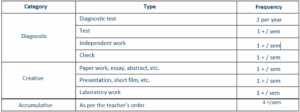
Task teams:
- Knowledge – name, select, expel, describe, define, specify;
- Understanding – paraphrase, combine, give examples, single out;
- Application – solve, draw, prepare;
- Analysis – compare, divide into categories, review;
- Synthesis – combine, plan, hypothesise;
- Evaluation – weigh, consider, criticise, support, justify.
Number of grades
Grading is done in accordance with the following principles:
- All pupils receive the same scheduled number of grades per semester.
- In case of failure to complete a test or non-participation in a test, the pupil is informed and another date for having a test is agreed (not during the lesson) during the following two weeks. If the pupil is not able to have a test for the same task (for example, task of listening, dictation, laboratory work, etc.), the teacher selects a task of similar scope and academic value (for example, essay, abstract, mental experiment, etc.).
- If the pupil repeatedly fails to take a test, the lowest grade (“1” in a scale of 1 to 10) and comment “Failed to take the test” are entered. The teacher decides whetherto give the student an additional chanceto take the test.
- If the pupil repeatedly fails to take a test, one week before the end of the semester, the gradebook is closedand the lowestgrade remains valid.
- Records of participation in competitions and Olympiads are made in the
- teacher’s diary and this is encouraged at the school level.
Parents must periodically receive feedback on pupils’ progress.
A formative evaluation, when parents are given feedback on individual progress of the pupil, applies in the primary classes:
- At the end of each month, in evaluating changes in the competencies of the pupil in the context of educational objectives. A short, written form is presented in the e-diary.
- Twice a year, at the end of the semester – a detailed progress evaluation report, is presented to parents in writing in the e-diary and is discussed during an individual meeting with parents.
- Separately, whenever needed, meetings with subject teachers can be arranged.
A criteria-based and formative evaluation is applied in the lower-secondary and secondary grades. Criteria-based evaluation, expressed in grades in a system from 1 to 10 points, is presented in the e-diary with short comments of the teacher. A formative evaluation is designed to give feedback on the individual progress of the pupil, according to the competencies to be achieved:
- Two months after the beginning of the school year – regarding the existing level of knowledge and competencies.
- Twice a year – at the end of the semester, a detailed progress evaluation report is presented to parents, in writing, in the e-diary and is discussed by the class leader during an individual meeting with parents.
- Meetings with subject teachers are arranged separately.
Request-form_red-1 (1) SWIMMING-POOL-INTERNAL-REGULATIONS IB PYP vertinimo tvarka __ Assessment Policy (Pradinis ugd.__Primary)
At Erudito Licėjus, the main channels of communication with parents are e-mail, ManageBac, Facebook groups, phone, or individual meetings. After entering the Lyceum, students receive an individual e-mail from Erudito Licėjus, which contains information on school issues.
Licėjus news and other relevant information is sent once a month in a newsletter, news is also published on the erudito.lt website, as well as on social media networks. Erudito Licėjus has Facebook, Instagram, LinkedIn and YouTube accounts, we invite you to follow and become actively involved.
During lessons, students cannot use mobile phones or other electronic devices unless the teacher gives them permission to use them for learning purposes. If necessary, parents can contact a student during the lessons through the class teacher or the administration.
If a student is sick or unable to come to the Lyceum for other reasons, parents are requested to inform about the student’s non-participation in the lesson and reasons on ManageBac. If the student does not come to school for more than a week due to illness or personal reasons, the parents inform the school.
At Erudito Licėjus, we pay special attention to the formation and development of all right habits, therefore a balanced diet is no exception, as it is especially important for the overall well-being of the student. At our school, all students eat according to a pre-planned menu that changes every four weeks. Our aim for all Erudito Licėjus students is to:
- receive appropriate amounts of calories, nutrients and vitamins for the day;
- familiarize with various products and methods of preparation;
- discover and enjoy a variety of food and vegetables.
Italian chef Gian Luca Demarco and his team take care of the nutrition for our students at Erudito Licėjus.
At Erudito Licėjus we will serve:
Breakfast (savory snacks, healthy pancakes, sandwiches rich with whole grain products, porridges)
Lunch:
- Main course, according to the menu (which guarantees a varied and well balances assortment everyday) or a vegetarian alternative can be chosen;
- Side dish of choice (two-kind) from various grains, potatoes (cooked, baked in the oven) and from porridges, pastas;
- Vegetables of choice (two-kind) from various salads (rich with various vegetables from tomatoes, cucumbers and lettuce to kale and celery roots, beetroots etc.) flavored with an assortment lentils, sunflower seeds, dried berries and fruits as well as chopped fresh or pickled vegetables, depending on the season;
- Soup.
Dinner.
Drinks and snacks. In the dining area on various days students will find water, juice, tea and a variety of fruits.
Meal time:
- Breakfast – after the 1st lesson block
- Lunch – after the 2nd lesson block
- Dinner – during informal education
Meals are paid for by issuing an invoice for the previous month based on the number of days the student attended school. Meals during formal education (breakfast and lunch) are compulsory – there is no possibility to choose one of the meals, to refuse it altogether, or to take your own food to school (unless there are medical reasons for it).
If your child is allergic and intolerant to certain foods, please send an allergist certificate stating the intolerable foods. We need to share this information with the food supplier three weeks in advance within three weeks at the latest in order to plana proper menu for the child for the month ahead.
The company supplying catering is UAB “Reikia pertraukos”
● Company code 306177779
● VAT number LT100015529913
● Aguonų g. 26, LT-03212 Vilnius
● E-mail: klientai@reikiapertraukos.lt
Menu examples here.
There are various extracurricular activity programs taking place. For pre-school and primary education classes, these activities are divided into main and additional blocks. The main block activities consist of creativity and art, games, reading, and other educational activities. The price is 150 EUR per month.
The additional block of activities consists of activities that require continuity: language clubs, chess, Lego robotics, programing, karate, basketball , theater, 3D modeling, and others. Prices are determined for each club separately.
After-School Activities will begin on September 3rd. No registration is required for after-school activities.
We will send the catalog of non-formal education activities and registration links by August 31st. For inquiries about after-school activities, you can contact: e.popamokine@erudito.lt.
Email. An email address is created for every student in school. The school uses the Google Suite. During the first ICT class, the teacher provides students with their school email address and password. During lessons, students learn with the help of teachers how to log in and use email.
The school-provided email is used for all school communication and logging into school systems. Only with this email can students access remote lessons on the Google Meet platform.
Office Suite. Each student attending school receives access to the Microsoft Office 365 environment, meaning students can use Word, Excel, PowerPoint, and other tools for free. These Office 365 logins are provided to students by the National Education Agency.
Internet. Students have access to the school’s wireless internet (WiFi). The ICT teacher demonstrates how to connect to the school’s wireless internet during the first lesson.
Chromebooks. Chromebook devices are a computer designed to help perform various tasks quickly and easily. All primary year students can use school Chromebook computers during lessons.
Recommendations for Student Computers. 5th-10th graders are required to have a personal laptop that they can use during lessons. High school students actively use electronic textbooks, exercises, programs, work in teams, and create projects. Below are the minimum recommendations for a work computer based on possible operating systems:
WINDOWS:
- Processor (CPU) speed not less than 2.30 GHz, Intel i5-7200 or newer;
- Screen not less than 13 inches;
- RAM not less than 8 GB;
- Operating system Windows 10 or Windows 11;
- Minimum disk capacity 120 GB;
- The computer must have a working camera and microphone;
MAC (MacBook):
- Model MacBook Air or MacBook Pro;
- Screen not less than 13 inches;
- Processor model not less than M1;
- RAM not less than 8 GB;
- Disk capacity not less than 120 GB;
- Operating system version MacOs 13 Ventura or newer;
- The computer must have a working camera and microphone;
We recommend that parents have an administrator account on the student’s computer. This will allow you to monitor the student’s online activity, restrict access to inappropriate content, and install software to ensure security and productivity.
It is also important for parents to install antivirus software on the student’s computer and update it regularly.
If you have any questions or would like to consult further before purchasing or upgrading a computer, please contact us by email: IT@erudito.lt
Diary. The school uses the ManageBac electronic diary. This diary provides students with the following functions:
- Viewing lesson schedules: Students can view their lesson schedules, including subjects, teachers, times, and locations.
- Submission of tasks and homework: Students can submit tasks and homework directly through the system, which can be reviewed by their teachers.
- Review of assessments: Students can review their assessments, including grades, feedback from teachers, and other important information.
- Submission of reports and projects: If a student needs to complete projects or write reports, they can do so through the ManageBac system by submitting their work to teachers through the platform.
- Communication with teachers: Students can communicate with their teachers through the ManageBac system, asking questions, receiving additional help, or advice.
- Monitoring progress: Using ManageBac, students can monitor their academic progress, including their grade history and progress reports.
These are just a few activities that a student can perform using the ManageBac system. This system is designed to streamline school management processes and help the school community communicate and manage academic affairs more effectively.
For parents of students in grades 5-12, if they have provided their contact information (name, surname, email address), access is granted to the school’s electronic diary.
Parents can log in to the ManageBac system:
- in the website managebac.com
- using the app. App available at https://www.managebac.com/about-mobile
The school sends login information and usage instructions to parents‘ personal email addresses.
If login information is not received and parents wish to access the ManageBac electronic diary, please contact the IT department at m.gecas@erudito.lt or d.galvanauskaite@erudito.lt
Parents using ManageBac can take several actions, including:
- Monitoring their child’s progress: Parents can review their child’s progress in all subject areas, including results, messages, semester reports, behavior notes and teacher comments.
- Viewing schedules: Parents can see their child’s schedule, including lesson times, homework deadlines, or events and trips.
- Communication with the school: Through ManageBac, parents can communicate with school staff, send messages, receive responses to questions, and receive messages from the school related to their child’s class or school.
- Absence reporting: Parents can report absences through the system.
Meeting registration. Registration for parent meetings, individual meetings with teachers, takes place through the SchoolsBuddy system. There are two ways to access the system:
- at https://erudito.schoolsbuddy.net/ and selecting “Login with ManageBac”
- through the ManageBac system directly.
Instructions on how to use the system are provided by sending an invitation to the meeting.