

2026-04-29
Monaco, the United States and Beyond: How Erudito Licėjus Alumni Are Building Their Futures Around the World
Luxury yachts, high-end cars, and some of the world’s most influential people are part of everyday life for Viktorija Morkūnaitė, a Business Management student at the International University of Monaco. Having chosen an unconventional study destination and a life in one of the world’s most luxurious cities, she encourages future students not to be afraid […]
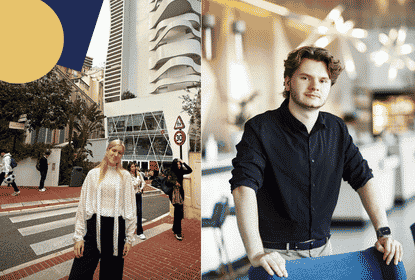
Luxury yachts, high-end cars, and some of the world’s most influential people are part of everyday life for Viktorija Morkūnaitė, a Business Management student at the International University of Monaco. Having chosen an unconventional study destination and a life in one of the world’s most luxurious cities, she encourages future students not to be afraid of stepping outside their comfort zones. According to Viktorija, unconventional choices help remove limitations and inspire people to aim higher.
Now in her first year at the International University of Monaco, Viktorija is delighted that her chosen degree provides numerous opportunities to meet prominent figures from the business world and discover how down-to-earth they can be. The Lithuanian student openly shares what it is like to combine studying and everyday life in such a luxurious city, what makes the university environment unique, what benefits its community offers, and what kinds of experiences students can gain in such an international setting.
– Could you tell us more about where you studied before moving abroad for university?
– I studied at Erudito Licėjus from Years 10 to 12, following the International Baccalaureate Diploma Programme. You could say that I was already surrounded by an international environment before university, because everything at school, apart from Lithuanian, was taught in English. My classmates and teachers came from all over the world. When I began considering studying abroad, I realised how valuable that experience had been.
– You took exams that differed from the Lithuanian national system. How did you do?
– The highest possible score in the International Baccalaureate Diploma Programme is 45 points, and I achieved 37. I would say that I did very well. Later, I found out that my result was considerably higher than the global average.
– Do you have any advice for students preparing for their exams?
– I think the most important thing is simply to begin, because we often tend to procrastinate. Instead of looking at a task as something enormous, it is better to start with one small step—for example, doing at least a little today. That alone is already significant progress. It is also important to make time for rest and, when you are resting, to genuinely rest rather than feel guilty about it.
– Studying in Monaco is an unconventional choice for Lithuanian students. Why did you decide to study there?
– I will admit that I felt very lost while searching for universities and deciding where to apply. I submitted applications to seven universities and was accepted by almost all of them. After receiving the offers, I heard from people I knew that a Business Management programme was also available at the International University of Monaco. I immediately liked the idea of studying there and quickly decided that it was where I wanted to go.
– What specifically attracted you to the International University of Monaco?
– First of all, Monaco itself sounded fascinating. It was very important to me that both the location and the university would interest and motivate me. I was looking for a university with a more practical approach, which I believe is especially important when studying business.
This university offers exactly that. We have many events attended by alumni and professionals who speak about their work and experience. There are also various student organisations that create many additional opportunities. For example, we had an event attended by store managers from several fashion houses. We were able to speak to them about internship opportunities as well as many other topics.
– What is life in luxury-filled Monaco like from a student’s perspective?
– I would say that Monaco has two sides. There are thousands of people who come here simply to work or study, but there is also the luxurious side of the city. Some of our classmates have aristocratic titles, but they are often very ordinary and approachable people. At university, everyone communicates as equals. Sometimes you do not even immediately notice that someone comes from such an exceptional background.
– What is the area around the university like? How visible is the luxury?
–
– As I mentioned, there are two sides. You certainly see students arriving in Rolls-Royces or owning Porsches, Ferraris, and similar cars. However, there are also students who are financing their studies through loans.
While living in Monaco, I have realised that what makes it feel luxurious is not only wealth but also the fact that it is extremely clean and safe. People also pay a great deal of attention to their appearance. For example, it is quite common to see students coming to university wearing suits.
– Are there other Lithuanian students at the university? How international is the university community?
– So far, I know three Lithuanian women and one Lithuanian man, although I believe there may be more. From what I have learned, the university has students representing more than 70 nationalities. I know people from China, Cambodia, the Scandinavian countries, Ukraine, and Monaco. The largest groups are French and Italian students.
– You mentioned that the university offers many practical opportunities and meetings with business professionals. Has there been one experience that stood out to you?
– One of the more memorable experiences was meeting the manager of a store belonging to a major fashion house. We spoke for around half an hour, and he explained what he looks for in employees. He also gave me advice on how to search for jobs and present myself professionally.
He seemed so down-to-earth that we also ended up speaking simply about life. In general, the events I have attended have shown me that highly influential people can be very approachable and willing to discuss all kinds of topics. Many of them are eager to support our generation and help students. You simply have to be brave enough to start the conversation.
– Ar be Jūsų dar yra studijuojančių lietuvių? Kaip apskritai šalių atžvilgiu atrodo universiteto bendruomenė? Kol kas žinau tris merginas lietuves ir vaikiną lietuvį, bet manau, kad jų yra ir daugiau. Kiek domėjausi, mano universitete iš viso yra virš 70 skirtingų tautybių studentų. Pažįstu žmonių iš Kinijos, Kambodžos, Skandinavijos šalių, Ukrainos, Monako. Daugiausia yra prancūzų ir italų.
– Where do you see yourself after graduation? Are you planning to return to Lithuania?
– I do not want to plan too far ahead because I am only in my first year at university. However, I think it would be very interesting to explore a career in either the yachting industry or private aviation. There are major opportunities in these sectors, and they genuinely interest me.
At the same time, I see myself as a global citizen, so perhaps I will end up living and working somewhere other than Lithuania or Monaco. Monaco encourages me to aim higher because every day I see highly influential people and extraordinary opportunities.
– What advice would you give students who are choosing where to study?
– It is important to understand what you personally want and what the university actually offers. Pay attention to the university’s values, but not only the ones listed on its website. Speak to current students and ask what the university truly prioritises, what it provides, and what it focuses on.
It may also be worth choosing a university in a place where you could imagine building your future. For example, it would be much more difficult for me to establish myself in Monaco without studying at the university. Being a student here gives me a much deeper understanding of the area and its community.
Delfi previously wrote about Kajus, a Lithuanian student studying in the United States. Kajus Ramonas, who studies Economics at Seton Hall University, says that the path towards a prestigious international education is not as difficult as it may seem—the key is to begin preparing early enough.
– When did your attitude towards education change?
– One evening, when I was in Year 9, I was sitting and looking at universities where I might like to study. At the time, I dreamed of studying at the National University of Singapore, one of the best universities in the world.
My mother then asked whether I thought I would be accepted if I continued studying the way I was studying at that time. Without hesitation, I answered no in my mind. Looking back, I can say that her question became a turning point. That evening, I decided to change everything—both the way I studied and the way I lived, including changing schools.
I needed a new environment, so the following academic year I enrolled at Erudito Licėjus. I wanted to study somewhere where English was widely spoken, creativity and critical thinking were encouraged, and students were better prepared for international university studies.
– KaiHow did you do at your new school?
– I studied at Erudito Licėjus from Years 10 to 12. I have dyslexia, so writing and studying in Lithuanian can be quite difficult for me. I completed my final two years in English through the International Baccalaureate Diploma Programme.
– How did you manage exams that were not based on the Lithuanian national system?
– In Year 12, I took both internal assessments and final examinations. Overall, I achieved good results in all of them.
– Did you follow a particular study strategy?
–
– In the IB programme, the most important thing is understanding how answers should be structured. It is a very clear system in which each question has defined assessment criteria. Once you understand exactly what teachers and examiners expect from you, studying becomes much easier and clearer.
International student communities and the learning materials available online helped me greatly. These included video lessons, teachers’ notes, other students’ summaries and explanations, and real examples of completed work. In a sense, I was not studying only with my own classmates but alongside thousands of IB students around the world.
– Why did you choose a university in the United States instead of Singapore?
– In the United States, university applications must be submitted before final examinations. Admission decisions are based largely on predicted grades and internal assessment results.
Because my overall predicted score was very high, I was not only accepted but also awarded substantial scholarships. I received offers from three universities—in Washington, Madrid, and Seton Hall near New York. I chose the United States because I felt I would learn far more there than if I remained in Europe.
– You have now been studying there for two years. How is it going?
– My studies are going well. I have noticed that university education in the United States is fundamentally different from what is offered in Europe. The system is different. In the US, studying is not only about reading—we actually do relatively little reading.
What matters is completing assignments, participating in student clubs, and gaining a great deal of practical experience. Students here are busy and independent, and responsibility for success is placed largely in our own hands.
I am included on the Dean’s List, which students qualify for by achieving a specified grade point average and meeting the required criteria. The highest possible GPA is 4.0, and mine is 3.984, which is why I am on the list.
– You are not only a student but also the president of the Economics Club. What inspired you to take on this role?
– Probably the American environment itself. You arrive, begin studying, and then naturally start asking yourself: what comes next?
Universities encourage extracurricular activities and the development of organisational and creative skills because these are considered part of the learning experience. Student government organisations are active, and I need to collaborate with them, prepare budgets, and carry out similar responsibilities. These skills are useful not only for my studies but also for life after university.
– What advice would you give current Year 8 and Year 9 students in Lithuania who would like to study abroad but lack confidence?
– First, do not limit yourself to a single university. It is good to have a dream university, but it is also useful to consider several alternatives. Even if you believe you already know which direction you want to take, plans can change in reality.
I would recommend beginning to plan and work consistently towards studying abroad from Year 10. It is also important to remember that applying to an international university requires a great deal of work and paperwork, while in Year 12 you are already preparing for final examinations. Several people I know took a gap year after secondary school simply so they could complete their applications properly, gain admission to the university they truly wanted, and avoid burning out.
I would also recommend visiting at least a few of the universities you are considering rather than applying blindly. Universities can be very different, so it is worth seeing several before making a final decision.
The goal should not simply be to complete an online application, receive an acceptance letter, and leave without looking back. A bachelor’s degree is an important stage of personal and academic development during which you learn a great deal about yourself. That is why it is valuable to begin early, explore your options, and gather information before making your final choice.
Join us
Register for a visit to the school and become part of our community!