

2026-08-24
Nerijus Pačėsa. Artificial intelligence is changing schools. The teacher’s role must change too
Ten years ago, when I was establishing our school, I often spoke about the fact that artificial intelligence would sooner or later become part of our daily lives. Even then, I believed we needed to start thinking about what children should learn in order to adapt, thrive, and feel confident in the world of the […]
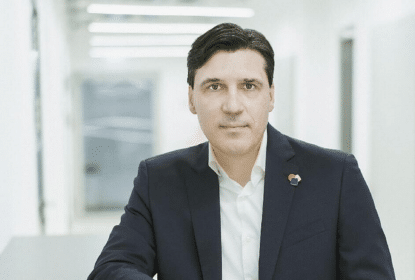
Ten years ago, when I was establishing our school, I often spoke about the fact that artificial intelligence would sooner or later become part of our daily lives. Even then, I believed we needed to start thinking about what children should learn in order to adapt, thrive, and feel confident in the world of the future.
At the time, many people considered this a distant prospect. Today, it is clear that the future has arrived.
Over the past few years, artificial intelligence has become part of everyday life. With each passing day, it plays an increasingly important role in how we live, while the pace of change continues to accelerate. That is why the most important thing today is to understand one simple truth: we may fear this technology, deny it, or ignore it, but that will not change its course. Artificial intelligence is here to stay, and it is becoming an integral part of our lives. Our task is to learn how to live and work alongside it.
The latest OECD Digital Education Outlook 2026 report reaches the same conclusion. It highlights that artificial intelligence has entered education far more rapidly than previous technologies. As a result, the key question is no longer whether teachers will use AI, but how they can use it in meaningful and responsible ways.
Talking about AI is not enough – teachers need to use it
In my view, the most important thing today is to see artificial intelligence as a tool. Like any other tool, it must be learned through practice. Listening to lectures, reading articles, or attending presentations about AI is not enough. The only way to understand its potential is to use it.
That is why the first step every teacher should take is to experiment confidently with artificial intelligence and integrate it into everyday practice. Today, there are already numerous learning platforms where AI makes it possible to personalise teaching for individual students, support teachers in lesson planning, and adapt learning experiences more effectively. These opportunities become visible only when we begin using them in practice.
This trend is already evident in schools. According to the OECD’s Teaching and Learning International Survey (TALIS), 37% of lower secondary teachers reported using artificial intelligence in their work over the past year, while 57% agreed that AI helps them prepare or improve lesson plans.
Teachers are making decisions before clear rules exist
At the same time, I see a far more complex side of this transformation. Teachers today face a growing number of legal, ethical, and moral questions. It is not always clear where and how artificial intelligence should be used, how to evaluate the quality and authenticity of AI-generated content, or where helpful support for students becomes something we should no longer consider acceptable. At present, there is still no comprehensive policy that answers these questions, which means teachers are often the first to face these dilemmas.
UNESCO has highlighted similar concerns. The organisation points out that the development of artificial intelligence is progressing faster than governments are able to establish clear frameworks for its use. As a result, teachers are increasingly responsible for addressing issues related to academic integrity, data protection, the reliability of AI-generated content, and the responsible use of technology.
The school of the future: the four “B”
There is one idea I strongly believe in. In my view, artificial intelligence brings us even closer to the model of the school of the future. I describe this vision through four principles.
First – without textbooks. Today, we have access to countless sources of information, which means learning no longer has to rely on a single textbook or a single learning pathway.
Second – without subjects. Real-life challenges are not divided into separate school subjects. Learning can therefore become more integrated, interdisciplinary, and project-based.
Third – without traditional lessons. Why should learning always fit into the same 45-minute lesson format? We should be open to exploring new ways of organising learning.
Fourth – without classrooms. Increasingly, meaningful learning can take place beyond the classroom through authentic experiences, real-world contexts, and engagement with the surrounding environment.
I believe that if teachers begin planning their work around these four principles, they will be better prepared for the school of the future.
Join us
Register for a visit to the school and become part of our community!